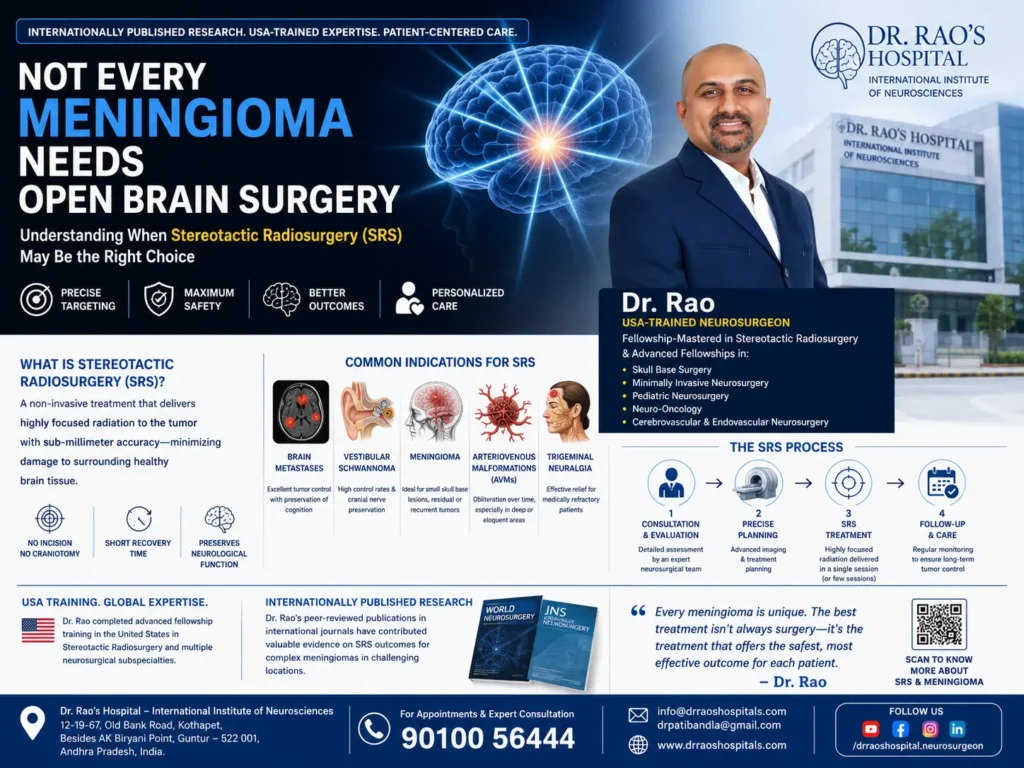
Stereotactic Radiosurgery in Guntur – Precise, Non-Invasive Brain and Tumor Therapy
For patients in Guntur seeking advanced, non-surgical cancer and neurological treatment, Dr. Rao’s Hospital offers cutting-edge stereotactic radiosurgery in Guntur. This highly targeted, non-invasive technique uses focused radiation beams to treat tumors, vascular malformations, and functional brain disorders—without the need for traditional surgery.
Stereotactic Radiosurgery in Guntur: Advanced Precision Treatment for Brain Disorders at Dr. Rao’s Hospital
When people hear the word radiosurgery, they often assume it involves a traditional operation. In reality, Stereotactic Radiosurgery (SRS) is one of the most advanced forms of minimally invasive treatment available in modern neuroscience. It uses highly focused radiation beams to precisely target tumors, vascular malformations, and functional neurological disorders while minimizing damage to surrounding healthy tissue.
At Dr. Rao’s Hospital – International Institute of Neurosciences (IIN), we are proud to offer advanced stereotactic radiosurgery solutions for patients across Guntur, Andhra Pradesh, India, and international locations. Led by Dr. Mohana Rao Patibandla, one of the leading minimally invasive neurosurgeons in India, our team has extensive experience in complex cranial, skull base, cerebrovascular, and radiosurgical procedures.
With experience in approximately 3,000 stereotactic radiosurgical procedures, Dr. Mohana Rao Patibandla combines international fellowship training with state-of-the-art technology to deliver personalized treatment plans for patients with brain tumors, arteriovenous malformations (AVMs), trigeminal neuralgia, and other neurological conditions.
What Is Stereotactic Radiosurgery?
Stereotactic Radiosurgery (SRS) is a non-invasive treatment that delivers highly focused radiation to a precisely defined target within the brain or spine. Despite its name, no incision is made, and no traditional surgery is performed.
The treatment works by directing multiple radiation beams from different angles toward a specific target. While each individual beam carries a relatively low dose, the combined radiation dose at the target is high enough to destroy abnormal cells while protecting nearby healthy tissue.
According to the Mayo Clinic, stereotactic radiosurgery is commonly used to treat brain tumors, vascular abnormalities, and certain functional neurological disorders.
Why Is Stereotactic Radiosurgery Important?
Traditional brain surgery remains an essential treatment option for many conditions. However, not every patient requires open surgery. In carefully selected cases, stereotactic radiosurgery can provide excellent outcomes with significantly less risk and faster recovery.
Advantages of stereotactic radiosurgery include:
- No surgical incision
- No blood loss
- Minimal hospital stay
- Reduced risk of infection
- High precision treatment
- Short recovery time
- Preservation of healthy brain tissue
For many patients, radiosurgery offers an effective alternative when traditional surgery is considered high risk due to lesion location, age, medical comorbidities, or personal preference.
Who Is a Candidate for Stereotactic Radiosurgery?
The success of stereotactic radiosurgery depends heavily on patient selection. At Dr. Rao’s Hospital, every patient undergoes a comprehensive evaluation that includes advanced imaging, neurological assessment, and multidisciplinary consultation.
Patients who may benefit from stereotactic radiosurgery include those with:
- Brain metastases
- Meningiomas
- Vestibular schwannomas (acoustic neuromas)
- Arteriovenous malformations (AVMs)
- Pituitary adenomas
- Trigeminal neuralgia
- Residual or recurrent tumors after surgery
- Lesions located in critical brain regions
Learn more about our advanced brain tumor services at: Brain Tumor Treatment at Dr. Rao’s Hospital.
Why Choose Dr. Mohana Rao Patibandla for Stereotactic Radiosurgery?
Choosing the right neurosurgeon is one of the most important decisions a patient can make. Dr. Mohana Rao Patibandla is internationally fellowship-trained in multiple subspecialties of neurosurgery, including:
- Skull base surgery
- Pediatric neurosurgery
- Neuro-oncology
- Cerebrovascular neurosurgery
- Endovascular neurosurgery
- Functional neurosurgery
- Stereotactic radiosurgery
His extensive experience in minimally invasive neurosurgery allows him to determine whether a patient will benefit most from radiosurgery, microsurgery, endovascular treatment, or a combination of therapies.
Patients searching for the best neurosurgeon in Guntur, best minimally invasive neurosurgeon in India, or advanced brain tumor treatment in Andhra Pradesh often choose Dr. Rao’s Hospital because of its commitment to evidence-based care and international treatment standards.
Conditions Treated with Stereotactic Radiosurgery
One of the major strengths of stereotactic radiosurgery is its versatility. It can be used to treat a wide range of neurological disorders.
The most common indications include:
- Brain Metastases
- Vestibular Schwannoma
- Meningioma
- Arteriovenous Malformation (AVM)
- Trigeminal Neuralgia
- Pituitary Adenoma
- Residual Brain Tumors
- Selected Functional Neurological Disorders
Each condition requires individualized planning to maximize treatment effectiveness while minimizing side effects.
Brain Metastases and Radiosurgery
Brain metastases are among the most common indications for stereotactic radiosurgery worldwide. Advances in radiosurgical technology have transformed the treatment of metastatic brain disease.
Instead of exposing the entire brain to radiation, stereotactic radiosurgery allows physicians to precisely target individual lesions while preserving cognitive function and quality of life.
This approach has become a standard treatment option in many modern neuro-oncology centers around the world.
Vestibular Schwannoma (Acoustic Neuroma) Treatment with Radiosurgery
Vestibular schwannomas, also known as acoustic neuromas, are benign tumors that arise from the vestibular nerve responsible for balance and hearing. These tumors typically grow slowly but can cause hearing loss, tinnitus, imbalance, facial numbness, and, in larger cases, brainstem compression.
Stereotactic radiosurgery has become one of the most effective treatment options for small to medium-sized vestibular schwannomas. The goal is not necessarily to remove the tumor but to stop its growth while preserving neurological function.
Compared to conventional surgery, stereotactic radiosurgery offers:
- Excellent tumor control rates
- Preservation of facial nerve function
- Lower risk of complications
- Minimal interruption to daily life
Patients with complex skull base tumors can also benefit from evaluation through our Skull Base Surgery Program.
Meningioma Treatment Using Stereotactic Radiosurgery
Meningiomas are among the most common primary brain tumors. Although many meningiomas are benign, their location can make treatment challenging, particularly when they occur near critical structures such as the optic nerves, brainstem, or cranial nerves.
Stereotactic radiosurgery is frequently recommended for:
- Small meningiomas
- Residual tumors after surgery
- Recurrent tumors
- Tumors located near critical neurovascular structures
Studies have demonstrated excellent long-term tumor control rates exceeding 90% in appropriately selected patients.
Arteriovenous Malformations (AVMs) and Radiosurgery
Arteriovenous malformations (AVMs) are abnormal tangles of blood vessels connecting arteries directly to veins without an intervening capillary bed. AVMs can cause headaches, seizures, neurological deficits, and life-threatening brain hemorrhage.
While microsurgery remains the preferred treatment for many AVMs, stereotactic radiosurgery provides a valuable option for lesions located in deep or eloquent regions of the brain where open surgery carries higher risk.
The radiation causes gradual thickening and closure of the abnormal vessels over time, eventually leading to obliteration of the AVM.
For patients with vascular disorders, visit our Endovascular Neurosurgery Program.
Trigeminal Neuralgia: Surgery Without an Incision
Trigeminal neuralgia is often described as one of the most painful conditions known to medicine. Patients experience severe electric shock-like facial pain triggered by routine activities such as eating, speaking, or brushing teeth.
For patients who do not respond adequately to medication or are not candidates for microvascular decompression surgery, stereotactic radiosurgery can provide effective pain relief.
The treatment precisely targets the trigeminal nerve root entry zone while minimizing radiation exposure to surrounding structures.
Many patients experience significant improvement in symptoms within weeks to months following treatment.
Pituitary Tumors and Radiosurgery
Pituitary adenomas are tumors that arise from the pituitary gland located at the base of the brain. While many pituitary tumors can be removed through minimally invasive endoscopic surgery, stereotactic radiosurgery often plays an important role in managing residual or recurrent disease.
At Dr. Rao’s Hospital, treatment decisions are individualized based on tumor size, hormonal activity, visual function, and overall patient health.
Learn more about advanced minimally invasive pituitary surgery: Pituitary Tumor Treatment.
How Does Stereotactic Radiosurgery Work?
One of the most common questions patients ask is: “How can radiation treat a tumor without harming the brain?”
The answer lies in precision.
Stereotactic radiosurgery uses sophisticated imaging and computer-guided planning systems to identify the exact location of a lesion. Multiple beams of radiation are then directed from different angles toward the target.
Each beam individually delivers a relatively low dose of radiation. However, where the beams intersect, the radiation dose becomes highly concentrated.
This allows physicians to:
- Destroy abnormal tissue
- Prevent tumor growth
- Preserve healthy brain structures
- Reduce treatment-related complications
The Stereotactic Radiosurgery Planning Process
Successful stereotactic radiosurgery requires meticulous planning.
The process generally includes:
- Comprehensive neurological evaluation
- High-resolution MRI and CT imaging
- Target contouring and treatment planning
- Radiation dose optimization
- Treatment delivery
- Long-term imaging follow-up
At Dr. Rao’s Hospital, every case is reviewed carefully to ensure that radiosurgery is the most appropriate treatment option.
Gamma Knife, CyberKnife, and LINAC: Understanding the Technologies
Patients frequently ask about the differences between Gamma Knife, CyberKnife, and LINAC-based stereotactic radiosurgery systems.
While the technologies differ, the fundamental principle remains the same: delivering highly focused radiation with maximum precision.
| Technology | Primary Use | Advantages |
|---|---|---|
| Gamma Knife | Intracranial lesions | Exceptional precision |
| CyberKnife | Brain and spine lesions | Robotic image guidance |
| LINAC-Based Systems | Brain and body tumors | Versatile treatment options |
According to the Congress of Neurological Surgeons (CNS), stereotactic radiosurgery has become a standard treatment option for numerous intracranial conditions.
Why Choose Dr. Rao’s Hospital for Stereotactic Radiosurgery in Guntur?
Patients travel from across Andhra Pradesh, Telangana, India, and international destinations to seek treatment at Dr. Rao’s Hospital because of our commitment to advanced neurosciences care.
Key advantages include:
- Internationally fellowship-trained neurosurgeon
- Approximately 3,000 stereotactic radiosurgical procedures performed
- Expertise in neuro-oncology and cerebrovascular disorders
- Comprehensive multidisciplinary care
- Advanced imaging and treatment planning
- Minimally invasive treatment philosophy
- Personalized patient-centered care
Under the leadership of Dr. Mohana Rao Patibandla, Dr. Rao’s Hospital has become one of the leading destinations for advanced brain, spine, and nerve care in India.
Patients searching online for the best neurosurgeon in Guntur, best brain tumor surgeon in Andhra Pradesh, best minimally invasive neurosurgeon in India, or stereotactic radiosurgery in Guntur often discover that comprehensive expertise and individualized treatment planning make the greatest difference in outcomes.
“`
Stereotactic Radiosurgery in Guntur – Accurate, Painless, and Effective
Stereotactic radiosurgery in Guntur at Dr. Rao’s Hospital provides a revolutionary option for patients with brain tumors, acoustic neuromas, pituitary adenomas, AVMs, trigeminal neuralgia, and other conditions. Our team uses high-precision planning and image guidance to deliver targeted radiation to abnormal tissues—minimizing harm to surrounding healthy areas. This outpatient procedure is painless and requires little to no recovery time.
Best Stereotactic Surgery in Guntur – Excellence in Targeted Brain Treatment
As pioneers of the best stereotactic surgery in Guntur, our neurosurgeons and radiation oncologists are skilled in using advanced radiosurgical platforms such as Gamma Knife, LINAC-based systems, or CyberKnife. Every case is evaluated individually, ensuring a treatment plan that is both safe and highly effective. Patients experience fewer complications, shorter recovery times, and often avoid the risks of open surgery.
Best Hospital for Stereotactic Radiosurgery in Guntur – Why Patients Trust Dr. Rao’s
Dr. Rao’s is widely regarded as the best hospital for stereotactic radiosurgery in Guntur. Our facility houses advanced radiosurgery suites, neuro-navigation software, and a dedicated neuro-oncology team. We are known for precision, safety, and compassionate care that supports each patient from consultation to follow-up.
Doctors for Stereotactic Radio Therapy in Guntur – Experts Who Personalize Every Case
Our experienced doctors for stereotactic radio therapy in Guntur bring together decades of clinical expertise in neurosurgery, radiation oncology, and neuro-imaging. They collaborate to plan the optimal dose and delivery method for each patient, ensuring accurate targeting with minimal side effects. Patients receive individualized guidance, second opinions, and detailed follow-up plans.
Stereotactic Radiosurgery Treatment in Guntur – Quick, Outpatient Recovery
Stereotactic radiosurgery treatment in Guntur is typically done as a day procedure. With no incision, no general anesthesia, and no prolonged hospital stay, patients return home the same day and resume normal activities quickly. The technology ensures sub-millimeter accuracy, which leads to excellent outcomes even for tumors located near sensitive brain structures.
Stereotactic Radiosurgery Treatment Near Guntur – Trusted by Patients Across the Region
If you’re looking for stereotactic radiosurgery treatment near Guntur, our hospital serves patients from nearby districts and towns. We offer access to highly specialized care without the need to travel far. Our dedicated support staff also helps patients manage appointments, accommodations, and follow-up logistics.
Explore More Locations: Stroke and Cerebrovascular Treatment in Narasaraopet | Stroke and Cerebrovascular Treatment in Vijayawada | Stroke and Cerebrovascular Treatment in Rajahmundry
Best Stereotactic Radiosurgery Hospital in Guntur – Comprehensive Oncology Support
Our integrated care model makes us the best stereotactic radiosurgery hospital in Guntur. In addition to radiosurgery, we provide diagnostic imaging, tumor board reviews, rehabilitation, and access to medical and radiation oncologists. This multi-disciplinary approach ensures continuity and completeness of care for every patient.
Radio Therapy Centres for Cancer in Guntur – Modern Facilities and Compassionate Care
Dr. Rao’s Hospital is among the most advanced radio therapy centres for cancer in Guntur. Our facility is designed for comfort and efficiency, with radiation therapy equipment operated by trained technologists and overseen by expert oncologists. We provide radiotherapy not only for brain conditions but also for cancers of the spine, head and neck, and other areas.
Radio Therapy Specialist in Guntur – Highly Skilled, Always Available
Our radio therapy specialist in Guntur is a core part of the neuro-oncology team. With deep understanding of tumor biology and radiation physics, they plan safe and effective treatment strategies for each patient. Their role also includes monitoring treatment progress, managing side effects, and offering supportive care.
Interventional Neurology and Endovascular Neurosurgery in Guntur – Enhancing Radiosurgical Outcomes
In complex neurological cases, combining interventional neurology in Guntur with radiosurgery provides an additional layer of precision and safety. Our interventional neurology in Guntur service uses advanced imaging and catheter-based techniques to evaluate and sometimes embolize vascular tumors or AVMs before radiosurgery, enhancing treatment success.
We also offer endovascular neurosurgery in Guntur for patients who require vascular access, embolization, or coiling procedures in preparation for or in conjunction with radiosurgical treatment. Our endovascular neurosurgery in Guntur experts work closely with neurosurgeons and oncologists to provide seamless, team-based care for complex tumor and vascular conditions.
Highlights Include:
- Interventional neurology in Guntur for tumor embolization and pre-radiosurgery vascular planning
- Endovascular neurosurgery in Guntur for managing vascular malformations and tumor blood supply
- Hybrid operating suites with real-time imaging and precision guidance
- Collaborative care across neurosurgery, oncology, and radiology
- Reduced risk of complications and improved radiosurgical outcomes
By integrating interventional neurology in Guntur and endovascular neurosurgery in Guntur, we offer patients with difficult or high-risk conditions a more complete, less invasive pathway to recovery.
Book a Consultation for Stereotactic Radiosurgery in Guntur
If you or a loved one has been diagnosed with a brain tumor, AVM, or neurological condition, and are exploring non-surgical options, reach out to our specialists today. Schedule your consultation for stereotactic radiosurgery in Guntur at Dr. Rao’s Hospital.
We’re here to help you heal—with less pain, less risk, and more peace of mind.
Frequently Asked Questions
Enquiry Now